TOTAL PAGE VIEWS

Tuesday, December 5, 2017

BLOOMBERG.COM Zarrab Recorded in Jail Saying `You Have to Lie' to Get Leniency

Zarrab Recorded in Jail Saying `You Have to Lie' to Get Leniency
Bob Van Voris, Christian Berthelsen, Chris Dolmetsch
Reza Zarrab, the Turkish currency trader who admitted helping Iran move billions of dollars in violation of U.S. financial sanctions, said in a recorded jailhouse conversation that he needed to lie about his own crimes to get a reduced sentence, according to a summary of his words.
Zarrab, the government’s star witness in the trial of Turkish banker Mehmet Hakan Atilla, testified for a fourth day Monday in Manhattan federal court. Atilla’s lawyers, who could begin cross-examining Zarrab as soon as Tuesday, complained to U.S. District Judge Richard Berman in a letter Monday that prosecutors dragged their feet in turning over recordings of the Sept. 15, 2016, conversation and four others.
Zarrab has testified that he was arrested and taken into custody by Turkish financial authorities on Dec. 17, 2013. Under questioning by Assistant U.S. Attorney Sidhardha Kamaraju, Zarrab said he made payments in connection with his release from prison.
"Were they bribes?" Kamaraju asked.
"In part," Zarrab said, without explaining further.
click on image to see larger

"Zarrab is proclaiming his willingness to fabricate testimony out of whole cloth in order to obtain a reduced sentence," Atilla’s lawyers argued in the letter, which was posted, then removed without explanation, from the publicly available court docket.
They claim the production of the evidence on Saturday at 10:42 p.m. "significantly impairs the ability of the defense" to use them at trial.
Zarrab, who was initially the key defendant in the case, spent a year in U.S. jails awaiting trial before agreeing last month to plead guilty and cooperate with the government’s case against Atilla. Though nine defendants have been charged, only Atilla, who was a deputy general manager at Turkiye Halk Bankasi AS, is being tried, and only Zarrab and Atilla are in U.S. custody.

‘In America’

In the letter, Atilla’s lawyers told Berman that Zarrab said on the jailhouse recording, "In America in order to make it out of prison you need to admit to something you haven’t committed."
Zarrab has testified to helping Iran make international payments by disguising them as payments for phony gold and food sales that were structured to make it appear that they complied with U.S. sanction regulations. On Thursday, Zarrab said he believed two Turkish banks were included in the scheme with the approval of Recep Tayyip Erdogan, who at the time was Turkey’s prime minister and is now its president. 

Zarrab has pleaded guilty to seven felonies, including conspiracy, sanctions violations, bank fraud and money laundering. He admitted bribing a corrections officers in the U.S. to sneak him alcohol and let him make cell phone calls.
The case is U.S. v Zarrab, 15-cr-867, U.S. District Court, Southern District of New York (Manhattan).
More from Bloomberg.com

Saturday, December 2, 2017

Friday, December 1, 2017

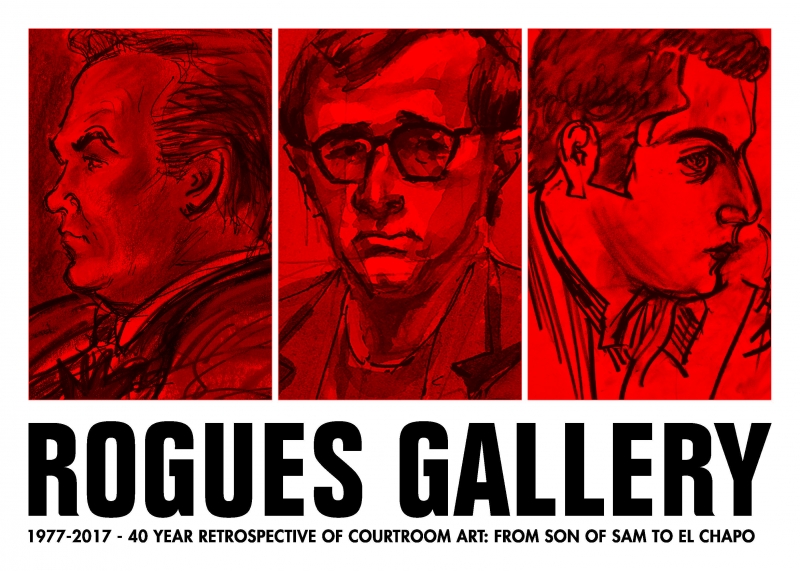
John Jay College Lloyd Sealy Library Exhibit- Rogues Gallery:40 Years of Court Art


Rogues Gallery postcard imageROGUES GALLERY: Forty Year Retrospective of Courtroom Art from Son of Sam to El Chapo
Curated by Larry E. Sullivan (Chief Librarian), Aggie Whelan Kenny, and Elizabeth Williams
On view November 30, 2017 to February 2, 2018
Rogue’s Gallery – 1977 – 2017 – 40 Year Retrospective of Courtroom Art from Son of Sam to El Chapo showcases the work of three award winning and nationally known illustrators: Aggie Kenny, Richard Tomlinson and Elizabeth Williams. Through their art, viewers will learn about the wide and varied actions of the United States legal system. The images (most never exhibited before) show various New York courts and cases.
Artist Richard Tomlinson bequeathed his entire body of work to the John Jay College of Criminal Justice’s Lloyd Sealy Library. Subsequently the Library’s courtroom art collection grew to include works by Aggie Whelan Kenny and Elizabeth Williams. This exhibition marks the fortieth anniversary of the Son of Sam case and the thirtieth anniversary of the Bernhard Goetz subway shootings. The John Jay exhibit allows observers to step into New York’s colorful historical trials and cases.

Link to buy the catalog 
 http://www.lulu.com/shop/anya-and-andrew-shiva-gallery-john-jay-college-of-criminal-justice/the-rogues-gallery/paperback/product-23404116.html

LocationShiva Gallery, located just inside the 11th Avenue entrance to John Jay College of Criminal Justice.
Address: 860 11th Avenue (between 58th & 59th St), New York, NY 10019.
The Shiva Gallery is free and open to the public Monday through Friday, 10am – 6pm. 
A large portion of the items on view are from the Richard Tomlinson, the Aggie Whelan Kenny, and the Elizabeth Williams Courtroom Drawings Collections, all housed in the Lloyd Sealy Library Special Collections.


Tuesday, November 14, 2017

COURTHOUSE NEWS>Defense Paints Indicted FIFA Officials as Clueless Outsiders

BROOKLYN, N.Y. (CN) – Emphasizing the scale of corruption that dominated soccer’s international governing body for decades, defense attorneys for three indicted former FIFA officials told a jury Monday that their clients were innocent bystanders.

Charles Stillman, an attorney for ex-Brazilian soccer head Jose Maria Marin, used an apt analogy at opening arguments this morning

In a children’s soccer game, the Ballard Spahr attorney explained, players are “part of an organized effort to score goals” and prevent the other team from scoring.
Marin may have belonged to Team FIFA, said Stillman, but he said the 85-year-old was “kind of like the youngster standing off to the side picking up daisies, looking around, while the others are running full steam ahead.”
“There is a crucial difference,” Stillman said, “between being on the field and being in the game.”
Marin is on trial for the next month and a half alongside 59-year-old Juan Angel Napout, the former president of the South American soccer confederation Conmebol, and 60-year-old Manuel Burga, a member of FIFA’s development committee who controlled Peruvian soccer from 2002 to 2014.
While prosecutors have netted scores of guilty pleas from other accused co-conspirators, Marin, Napout and Burga have all pleaded not guilty to allegations of a comprehensive racketeering scheme where FIFA officials for years traded media and marketing rights to soccer events for more than $200 million in bribes.
Assistant U.S. Attorney Keith Edelman highlighted the power that soccer officials wield in football-loving Latin America, saying the defendants abused that power and used “our financial system to carry out the scheme.”
“These defendants cheated the sport in order to line their own pockets with money that should have been spent to benefit the game,” he told the 12-member jury.
Edelman said the government’s case includes “detailed ledgers, contracts, emails, hotel records and more,” and that the jury will hear witness testimony from media executives and other former FIFA officials who have already pleaded guilty to the conspiracy.
Burga’s attorney Bruce Udolf accused the government of using “too broad a brush” and sweeping up “lower-level people like Manuel under this RICO umbrella.”
Prosecutors then “left it to you to sort out,” Fort Lauderdale-based Udolf told the jury, gesturing enthusiastically while pacing at the podium from which he delivered his opening statement.
“Lots of people got money, lots of people paid money — but not Manuel Burga,” the attorney added.

Silvia Pinera-Vazquez, an attorney for Napout, painted a picture of the U.S. government “making up its mind that Mr. Napout was dirty because he was the president of Conmebol and working backwards” to find evidence of the charges.

“Soccer is a little bit more than a passion in Latin America,” Miami-based Pinera-Vazquez said. “It’s a religion. The community revolves around soccer.”
Dressed in a dark suit, Marin reached over the wall separating the gallery from the rest of the courtroom to clasp his wife’s hand during a break in this morning’s proceedings.
Burga, more aloof, paced with his hands behind his back during the break. Napout wore a gray suit and blue tie and appeared relaxed.
Their trial is expected to last five or six weeks.

Friday, November 10, 2017

Ezekiel Elliott fallout: Roger Goodell keeps on end-zone dancing all over players and they have themselves to blame

Ezekiel Elliott fallout: Roger Goodell keeps on end-zone dancing all over players and they have themselves to blame

 Link to entire story. Excerpts below

https://www.yahoo.com/sports/ezekiel-elliott-fallout-roger-goodell-keeps-end-zone-dancing-players-blame-021005497.html


Jeffrey Kessler attorney for the NFL Players Union and Ezekiel Elliot in Manhattan Federal Court. Elliot seated left behind his attorney.  Judge Katherine Polk Failla presiding

One by one, lawsuit by lawsuit, decision by decision, NFL commissioner Roger Goodell is ascending to disciplinary emperor. And in the wake of the Ezekiel Elliott case, his reign over the players is looking more untouchable than ever.
For NFL players and their union, that’s the fallout from Thursday, when a federal appeals court in New York all but guaranteed Elliott will serve his six-game suspension for violating the league’s domestic violence policy. For Goodell and his legal department, the victory comes despite a few judges along the way questioning whether the league’s punitive process is fundamentally fair. It also comes in the face of one of the NFL’s investigators stating her own suspension objections after weighing evidence in the case.
Yet even in the face of those concerns, Goodell has ridden out a litany of legal challenges and prevailed once again, bolstering a nebulous disciplinary process that may never be penetrated.

The Dallas Cowboys' Ezekiel Elliott walked away a loser in his federal case against the NFL. (AP)
The Dallas Cowboys’ Ezekiel Elliott walked away a loser in his federal case against the NFL. (AP)
As it turns out, this NFL emperor not only has clothes, he’s got a legal suit of armor.
The NFLPA gave it to him in the collective-bargaining agreement, and now its players are paying for legal upgrades, too. That’s what is happening with Elliott, whose case may end up damaging the union.
Judge Katherine Polk Failla

What is left on the docket? The Dallas Cowboys’ star running back will ride out an expedited appeal through the U.S. Court of Appeals in the 2nd Circuit that is set to hear oral arguments on Dec. 1. Unless there is a miraculous revelation, Elliott is likely to lose his appeal. Even with a new panel of judges from the 2nd Circuit, it would be a stunning development to have the court ultimately determine that his appeal arguments were more worthy of a legal win than the simple injunction he was just denied.
And if (or when) Elliott suffers an appeals loss? His legal team could get extremely ambitious and attempt to secure a moonshot appearance before the U.S. Supreme Court, something New England Patriots quarterback Tom Brady didn’t bother to try in deflate-gate. Getting the highest court in the land to hear Elliott’s case would be a monumental accomplishment as it would also be far outside of the norm. The Supreme Court typically takes cases that either have broad and sweeping implications or require a resolution for conflicting decisions from lower branches of federal court. Elliott’s collective-bargaining complaint meets neither standard.
Tom Brady in court 2015
Elliott may try anyway, but when those roads meet a dead end and he is left with no other options, the ripples will have already set in for the NFLPA. And those are this: His federal case and the precedent it helps solidify will be put down right next to Brady and Adrian Peterson – all of whom took the NFL to court over the CBA, and all of whom lost.
Ultimately, that will be three extremely strong pillars holding up Goodell’s power and the NFL’s ability to dictate justice in almost any manner. Each damaging in its own way. Peterson’s case illustrated to the NFL that it has latitude to discipline players as it sees fit; Brady’s case bolstered the league’s reliance on scant (and arguably circumstantial) evidence; and Elliott’s case brought both of those realities together in one legal battle.
The potentially damaging outcome for players might be even more severe due to Elliott’s case. For the first time, it showcased that the NFL can essentially run its own in-house investigation however it wants and still be protected by federal courts – so long as the league goes through its own arbitration process, which has also been painted as rigged. If that doesn’t illustrate the remarkable power that Goodell holds, nothing does.


Tuesday, November 7, 2017

BLOOMBERG: JPMorgan Judge Upends $1.1 Million Whistle-Blower Verdict

JPMorgan Judge Upends $1.1 Million Whistle-Blower Verdict

Updated on
  • Verdict comes after eight years of delays and appeals
  • Judge says jury ‘prejudiced’ against JPM, may order new trial 
    Douglas Wigdor attorney for plaintiff Jennifer Sharkey,  addresses jury
It took Jennifer Sharkey more than eight years to get a trial over her dismissal from JPMorgan Chase & Co. A Manhattan jury needed only five hours to find the former wealth manager was fired illegally and award her $1.13 million in damages. Then, it took just an hour for a Manhattan judge to upend the verdict and send the whole case back to square one.
A jury of five women and three men found that the bank retaliated by firing Sharkey after she recommended the dumping of a client whom she suspected of fraud and money laundering. The panel rejected the bank’s claim that Sharkey was dismissed because she lied to her boss on multiple occasions. Sharkey was awarded $563,000 in back pay and $563,000 for emotional damage.
That was before lunch on Tuesday. A little more than an hour later, U.S. District Judge Denise Cote said she’ll likely order a new trial if the two sides don’t hammer out a settlement because the verdict is "substantially flawed."
"The award of emotional damages says to me that the jury was prejudiced against the bank," Cote said after JPMorgan Chase asked her to throw out the jury verdict. "That undermines the entire verdict."
Both sides declined to comment after the hearing.
Sharkey claimed she was let go in 2009 after telling her superiors she planned to recommend that JPMorgan Chase end its relationship with a client who had about $14 million at the bank. She testified she was worried the diamond seller who had also founded a phone calling-card business might have been involved in fraud and money laundering.
“I was fired the next day,” Sharkey testified in Manhattan federal court.

Rare Trial

The case marked a rare trial of Sarbanes-Oxley whistle-blower claims in a dispute that got its start in the months following the discovery that Bernard Madoff used JPMorgan Chase bank accounts in his Ponzi scheme. Because of a pretrial ruling by the judge, Sharkey wasn’t allowed to testify about client-screening procedures at JPMorgan Chase in the wake of the Madoff fraud.
"Of course I’m very happy -- 8 1/2 years," Sharkey said before the jury’s verdict was thrown into question by the judge.
Sharkey got her day -- a week, actually -- in court after years of delays, including two appeals that reinstated her claims. A judge who said at a pretrial hearing that he’d “do anything to get rid of this case” withdrew from the case and was replaced with Cote.
Jurors were forced to contend with an alphabet soup of letters that stood in for the names of people and companies. The client who raised Sharkey’s suspicions, for example, was referred to as Client A to protect his identity. Other characters in the story were given the names Client H, Manager T and Client BW.

Former Boss

Sharkey’s former boss, Leslie Lassiter, testified that she lied numerous times when asked if she’d contacted the office of another client and that was the reason for her firing. The client’s office manager called to complain that Sharkey hadn’t returned calls and asked whether the wealth manager was just “a phantom," according to Lassiter.
The trial quickly turned into a personal battle between Sharkey’s story and Lassiter’s. Each side accused the other’s star witness of lying.
Two JPMorgan Chase executives, Joe Kenney and Adam Green, were found by the jury not liable, conclusions the judge said she would leave intact.

Cote said she believed the fact the jury awarded the same amount in emotional damages as in back pay meant they were in fact trying to award punitive damages, against her instructions. She said she believed the evidence showed that Sharkey was fired for lying and that a rational jury couldn’t have found that she reasonably believed the diamond broker violated any laws, such as money laundering or fraud, spelled out in the Sarbanes-Oxley protections.
"It’s with sadness that I make these findings because I know you have all been engaged in a very long journey here," Cote said.
The bank’s legal team reacted with hugs and backslaps.
The case is Sharkey v. JPMorgan Chase & Co., 10-cv-03824, U.S. District Court, Southern District of New York (Manhattan).

Monday, November 6, 2017

CENTER FOR ART LAW: The Factual and Legal Background of the 5Pointz Trial

The Making of the Moral Rights Case: The Factual and Legal Background of the 5Pointz Trial 

Update >>

5 Pointz artists awarded damages for whitewashed graffiti at L.I.C. art mecca 


Link to full story
https://itsartlaw.com/2017/11/05/the-making-of-the-moral-rights-case-the-factual-and-legal-background-of-the-5pointz-cases/
By Laura B. Richardson*
5Pointz, the world renowned “graffiti mecca” as it was once known, has become the subject of a legal battle which has culminated in a jury trial in the Eastern District of New York. Cohen v. G&M Realty L.P., 2017 U.S. Dist. LEXIS 50943 is a case brought by twenty-one graffiti artist plaintiffs against the defendant property owners of the 5Pointz buildings, for the destruction of 49 aerosol artworks (numbers of plaintiff-artists and works have been changing between 2013 and 2017). The artists are suing for infringement of their rights under the Visual Artists Rights Act 1990 (“VARA”), 17 U.S.C. § 106A, which protects rights of living artists whose visual art works are of recognized stature. 

 
Artists in court during the testimony of Jerry Wolkoff
Street Artists Go to Court
On October 10, 2013, artists, represented by Jeannine Leigh Widmer Chanes, sought a federal court order to preliminarily enjoin the destruction of the buildings, invoking their Visual Artists Rights Act 1990 (VARA) rights. On October 17, 2013, the Eastern District Court issued a temporary restraining order against the property owner, enjoining Wolkoff from altering the building in any way whilst the Court considered the plaintiffs’ motion. On November 12, 2013 the Court lifted the restraining order and denied the plaintiffs’ request for preliminary injunctive relief. Judge Block indicated that a written opinion would follow, and on November 20, his opinion explained that going to the issues of both irreparable harm and the balancing of the hardships, “the transient nature of the plaintiffs’ works” was the “ineluctable factor which preclude[d] either preliminary or permanent injunctive relief.” 

Between November 12 and November 20, Wolkoff apparently denied artists access to 5Pointz and on November 19, he ordered 5Pointz whitewashed overnight, without any notification to the artists. In his deposition on Friday, November 3, 2017 Wolkoff admitted that he hired and paid in cash a crew of painters, who began covering 5Pointz with white (and blue and black) paint at 4 a.m.. Some of the murals were covered in their entirety, while others were partially obscured by whitewash, with ghosts of the mutilated art peeping from under the quick job of reclaiming 5Pointz by its legal owner. The compound structures were not actually demolished until months later in August 2014.

The artists subsequently sued, seeking damages for the destruction of visual works of art at 5Pointz, in violation of their rights under the Visual Artists Rights Act 1990. 

Jerry Wolkoff on the stand cross examined by Eric Baum attorney for the 5 Pointz artists. During his brief testimony he admitted to covering the works so as to save the artists from the distress of seeing their art destroyed during the demolition. He also testified that he had heard the artists were going to attempt to hinder the building's demolition by forming a human circle. He also said he did not want them to get arrested if they were to attempt to stop the demolition.
In the defense’s opening statement on October 17th of the inaugural jury truly to hear a VARA case, Wolkoff’s attorneys characterized the whitewashing as a humanitarian act, “ripping off the Band-Aid” and covering the works so as to save the artists from the distress of seeing their art sit on the walls waiting for demolition for several months.

Art expert Renee Vera testifying to the value of the street artists work that was destroyed on 5Pointz. Esteban de Valle's artwork highlighted on screen.

5Pointz Chronology
1971– Jerry Wolkoff purchases property at 45–46 Davis Street Long Island City, Queens, New York.
1993 – The site is established as the “Phun Phactory” and Wolkoff grants artists permission to paint on building.
2002 – Jonathan Cohen becomes curator of 5Pointz.
2002-2013 – 5Pointz becomes internationally recognized “open air aerosol art museum” and “mecca of graffiti art” as top street artists flock to New York to paint at 5Pointz and tourists visit from all over the world to experience the murals at 5Pointz.
2010 – Real estate boom and sharp increase in property value in the Long Island City area.
August 21, 2013  New York City Landmark Preservation Commission denies granting 5Pointz landmark status.
August 21, 2013 – The City Planning Commission issues building permit authorizing the destruction of the 5Pointz buildings and the building of two-high rise towers containing 800 luxury rentals and more than 200 affordable units.
October 10, 2013 – Plaintiffs file complaint and motion for preliminary injunction to prevent the destruction of the premises, invoking their VARA rights.
October 17, 2013 – Court issues a temporary restraining order against the property owner.
November 12, 2013 – Court issues an order denying plaintiffs’ request for preliminary injunctive relief to prevent the destruction of their paintings.
November 19, 2013 – Whitewashing of building occurs overnight.
June 17, 2014 – Plaintiffs file the Cohen Complaint. In it, four claims are pled: (1) VARA, (2) intentional infliction of emotional distress (“IIED”), (3) conversion, and (4) property damage. 
August 2014– Demolition of whitewashed 5Pointz buildings.
June 3, 2015 – Maria Castillo and other artists (“Castillo Plaintiffs”) initiate a separate lawsuit against the defendants (“Castillo Matter”). As in Cohen, the Castillo Plaintiffs adduce the same four claims in their pleadings.
October 17, 2017 – Trial begins in Federal court, J. Block presiding.
* * *
*About the Author: Laura B. Richardson is serving as the Fall 2017 Postgraduate Legal Fellow with the Center for Art Law. She obtained her LLB from King’s College London in 2016 and is currently an LLM candidate at NYU School of Law with a specialization in Competition, Innovation and Information Law. She can be reached at lbr312@nyu.edu


Saturday, October 28, 2017

2K REVIEWS: 10 Best Car Air Fresheners of 2017-18: For Amazing Fragrance in Your Car

10 Best Car Air Fresheners of 2017-18: For Amazing Fragrance in Your Car

 LINK to the 10 BEST  >>http://www.2kreviews.com/best-car-air-freshener/


One of the most underrated things about getting a new car is that elusive new car smell. It’s hard to pinpoint why that scent is so alluring, but one thing is for sure: it doesn’t last forever.

Eventually, life happens, and your car will eventually lose that scent to a combination of other smells, whether it’s smoke, ozone, spilled drinks, food, pets, or pretty much anything else.
Car air fresheners are an obvious solution that can help you do everything from providing a more pleasant smell and environment in your car, to neutralizing odors with a faint, fresh scent. You certainly have plenty of choices depending on your preference.

With so many different choices and types, it can be hard to find the best air freshener for car that you actually need. So, we’ve done the work for you and prepared this best car air freshener reviews list by analyzing a number of different products,
Little Trees/Car Freshener vs  Exotica  trademark infringement lawsuit. 

Wednesday, October 18, 2017

Don’t Put Trump Above the Law, Emoluments Challengers Urge

Don’t Put Trump Above the Law, Emoluments Challengers Urge


ADAM KLASFELD COURTHOUSE NEWS 

https://www.courthousenews.com/dont-put-trump-law-emoluments-challengers-urge/


MANHATTAN (CN) — For the first time in U.S. history, ordinary citizens fought in court Wednesday to have a president’s business dealings declared as violations of anti-corruption provisions of the Constitution.
“Diplomats are bragging that they’re going to this president’s hotel to curry favor with him,” attorney Deepak Gupta argued this morning in the unprecedented hearing. ( Click on image to see larger)
Representing the watchdog CREW, short for Citizens for Responsibility and Ethics in Washington, Gupta wants a federal judge to declare Trump’s business dealings in violation of the foreign and domestic emoluments clause of the Constitution.
Judge George Daniels asking questions of attorneys
 During 2 1/2 hours of arguments before U.S. District Judge George Daniels, attorneys representing the executive branch and private citizens sparred both on the interpretation of these previously obscure statutes and the federal judiciary’s role in enforcing it.

Deputy Assistant Attorney General Brett Schumate

 “The court lacks jurisdiction to issue an injunction against a sitting president of the United States,” Deputy Assistant Attorney General Brett Schumate argued.
Blasting this as an “extreme view,” Gupta described this interpretation of the separation of powers as a recipe for impunity.
“I want to address the government’s view that the president is above the law,” Gupta said.
To earn the right to take the president to court, Gupta will have to prove not only that the president’s business dealings are illegal, but that his clients have been harmed by them.
---------------------------------------------------------------
The judge said he would rule in 30-60 days.

For more in this issue.
NY Magazine article link
 http://nymag.com/daily/intelligencer/2017/10/judge-weighs-whether-trumps-earnings-are-unconstitutional.html

Thursday, October 12, 2017

Embattled ex-HSBC Johnson Pushes Back on Allegations, ‘Fair all around’

Embattled ex-HSBC Johnson Pushes Back on Allegations, ‘Fair all around’

Regulation ( Institutional FX 


Mark Johnson on witness stand questioned by his defense attorney Frank Wohl. When asked how he described the eventual outcome of the deal, he responded: “I was surprised. It was a lot better than expected outcome for HSBC. But I felt it was fair all round . . . For the risk that HSBC took, the outcome was fair.”( click on image to see larger)

Defense Expert Kevin Rodgers on the witness stand. HSBC Mark Johnson trial. Rodgers,  former head of foreign exchange trading for Deutsche Bank told the New York federal jury weighing the criminal case against Johnson  that “pre-hedging,” or making some of a large currency purchase in advance, is a standard practice that can be beneficial to the buyer because it keeps the price down. ( click on image to see larger)

From the onset of the trial Johnson has been on the defensive after facing particular damning testimonial evidence. Recorded conversations picked up code words to his fellow traders, including the phrase ‘my watch is off’, which ultimately triggered the frenetic buying action from the traders.
Artwork by Elizabeth Williams 

Monday, June 5, 2017

Puerto Rico Bankruptcy: Judge freezes payments to COFINA bondholders

NOTICEL: Judge freezes payments to COFINA bondholders

by Damaris Suarez

Judge Laura Taylor Swain Tuesday suspended payments to the Bondholders of the Appealing Interest Fund Corporation (COFINA) and ordered that the money from the Sales and Use Tax (IVU) corresponding to these funds be kept in custody Of its fiduciary the Bank of New York Mellon until it solves the controversy in its merits.
In this way, the judge determined to grant the motion of interposition of the Bank of New York Mellon , which will have to keep in a reserve account and pay a kind of bond of $ 1,000.00 monthly in the Federal District Court in San Juan. It issued an order to paralyze and consolidate all claims related to these funds until the controversy over who gets the COFINA funds is resolved.
"Leaving the money in a Bank of New York Mellon reserve until the Court determines who is the same is the best way to make sure we have an orderly process, not an improper distribution," she said.
The next COFINA payment was due on Thursday, June 1st. The judge also paralyzed subsequent payments due in July and August. The bondholders of COFINA were the only group that had received uninterrupted money since last year the government determined that it could not honor its debts

Kurt. F. Gwynne, a lawyer for the Bank of New York Mellon, opened the hearing explaining that due to internal disputes between the principal and subordinated bondholders the Court's urgency should be to determine whether the banking institution should issue the payment due on Thursday and What to do prospectively with funds from the IVU.
Likewise, he questioned the participation of bondholders of general obligations in the discussion of the case since they have no interest in COFINA. "This is not the case to determine the constitutionality of these funds," Gwynne said.
The legal representative of the general bond bondholders, Gary Orseck, stated that according to the doctrine they must have access to the funds destined to COFINA. "That the government benefits from the funds that COFINA now has to offer services and the GO's are paid," said the lawyer.
During her participation in the process, the legal representative of the Financial Advisory Authority and Fiscal Agency (AFAAF), Susan Uhnan, stated that the public corporation favored continuing to honor payments to COFINA.
COFINA is the legal entity created during the administration of Aníbal Acevedo Vilá as a mechanism to issue debt based on revenues from the Sales and Use Tax (IVU) as a source of repayment, so that their payments were insured.
The judge opened her eyes giving condolences for the death of Lcdo. Scott K. Rutsky of the Proskauer firm, legal counsel to the Fiscal Control Board (JCF).